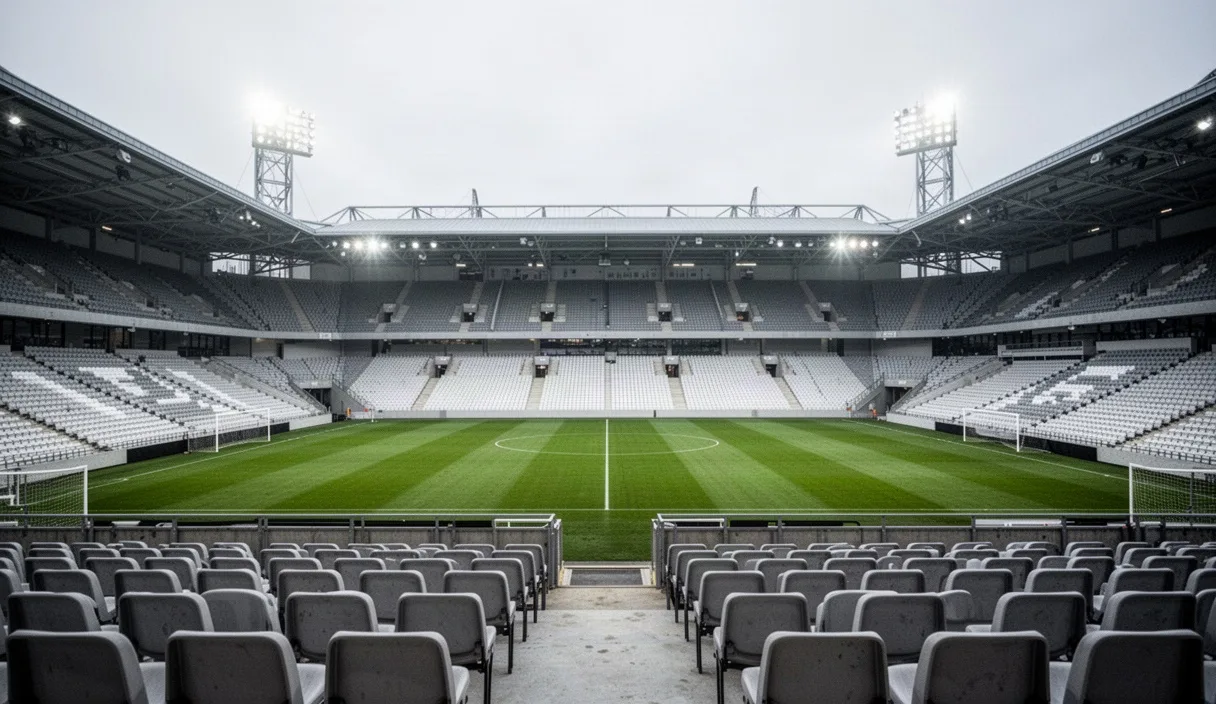

Your first live match is not like watching on television. There is no replay, no commentator explaining the offside call, and no zoom lens finding the ball for you. You are one person in a stadium of thousands, and the game will not slow down to help you catch up. This checklist covers the practical questions that matter before kickoff: what you can carry in, when to show up, how to read the scoreboard and the officials, and how to use the crowd itself as a source of information.
None of this requires expert knowledge of tactics. It requires knowing where to look, what the stadium staff will and will not let you bring, and how to plan your day so you are not still finding your seat when the anthem starts. Treat this as a pre-match routine, the same way a groundskeeper checks the pitch before the players arrive.
What to bring and what stadiums usually restrict
Most stadiums publish a bag policy on their website, and it is worth reading the week before, not the morning of. A common standard is a single bag no larger than 30cm x 30cm x 15cm, though some clubs allow larger bags and others ban bags entirely except small clutches. Check the specific venue rather than assuming a league-wide rule.
Outside food and drink are usually restricted, but not always banned outright. Some stadiums allow a sealed plastic bottle of water under 500ml; others confiscate any liquid at the gate. Selfie sticks, umbrellas with a pointed tip, air horns, and flares are near-universal prohibitions because they are classed as items that can be used as weapons or fire hazards.
A short list of what tends to travel well:
- A valid ticket, printed or on your phone with the screen brightness turned up for scanning.
- A form of photo ID matching the name on the ticket, since some clubs check this at the gate for named tickets.
- Cash and a card, since some concession stands are card-only and others are cash-only.
- A phone charger or power bank, since stadium wifi and heavy phone use during the match drains batteries fast.
- Earplugs if you are sensitive to sustained noise above 100 decibels, which is common in a full stadium during a goal celebration.
Leave professional cameras with detachable lenses at home unless you have applied for media accreditation. Most clubs classify any lens over a certain length, often 75mm, as professional equipment and will turn it away at the gate.
When to arrive and why
Arrive at least 60 minutes before kickoff for a first visit. This is not because you need an hour to find your seat, it is because you do not yet know the layout of the stadium, where your entrance gate is relative to the parking or transit stop, and how long the security line will take.
Security screening at larger stadiums, anything above 40,000 capacity, can take 15 to 20 minutes during peak arrival windows, which is usually the 30 minutes before kickoff. If you arrive at that peak window, you may still be in line when the players walk out.
Arriving early also gives you time to watch the warmup, which is genuinely useful for a beginner. Warmups run 30 to 45 minutes before kickoff and let you see which players are moving well, who looks injured or restricted, and which goalkeeper is taking shooting practice at which end. This is free information that the broadcast rarely shows in full.
A simple arrival plan looks like this:
- Confirm your gate number from the ticket, not just the stadium address.
- Plan to be through security 45 minutes before kickoff.
- Find your seat and note the two nearest exits, not just the one you entered through.
- Locate the nearest concession stand and restroom before you sit down, since lines form fast once the match starts.
How to read the electronic board and officials
The electronic board held up during substitutions shows two numbers stacked or side by side: the player coming off on top or left, the player coming on below or right. Cross-reference these numbers against the matchday program or the team lineup sheet, since squad numbers do not always match what you expect from television coverage.
Stoppage time is shown on the same board near the end of each half, usually held up around the 45th and 90th minute mark. A "+3" means three minutes will be added to that half for stoppages like injuries, substitutions, or VAR reviews. This number is a minimum, not a guarantee; referees can and do play longer.
Officials communicate more than most beginners realize. The referee's arm raised straight up with a flat hand signals a stoppage for injury or review. A rectangle drawn in the air with both hands signals a VAR review is underway, and this can pause the match for two to five minutes while the decision is checked on a pitch-side monitor. Assistant referees hold a flag horizontally for offside and vertically for a throw-in or substitution nearby; the flag position tells you which team benefits before the main screen confirms it.
| Signal | Who gives it | What it means |
|---|---|---|
| Raised straight arm, flat hand | Referee | Play stopped, usually injury or review |
| Rectangle traced in the air | Referee | VAR review in progress |
| Flag held horizontal | Assistant referee | Offside called |
| Flag held vertical | Assistant referee | Throw-in or nearby restart |
| Two numbers on the board | Fourth official | Substitution, player off top, player on bottom |
Following a single player instead of the ball
Television broadcasts follow the ball almost exclusively, because that is what a single camera operator can do. In the stadium, you have a wider field of view, and the more useful habit for a beginner is to pick one player, usually a central midfielder or a fullback, and watch them for five consecutive minutes regardless of where the ball goes.
This shows you what the broadcast hides: how far a player runs without the ball, how they position themselves before a pass arrives, and how they communicate with teammates through pointing and shouting. A central midfielder in a 90-minute match commonly covers 10 to 12 kilometers, and most of that ground is made without the ball anywhere near their feet.
Try this in blocks. Pick a player at kickoff and track them for the first 10 minutes. Switch to a player on the opposing team for the next 10. By halftime you will have watched four different players closely, and you will understand the shape of the match far better than someone who only tracked the ball.
Understanding crowd noise as information
Crowd noise is not just atmosphere, it is a live signal you can read. A sudden collective gasp followed by silence usually means a missed chance or a shot that hit the frame of the goal, since fans process a near-miss faster than a commentator can describe it. A rising noise that builds over three or four seconds before peaking usually tracks a dangerous attacking move, and the peak itself tells you whether it ended in a goal, a save, or a block.
Home fans directly behind one goal, often called the "kop" end or ultras section depending on the country, will sing continuously regardless of the score. A break in that singing, even for 10 or 15 seconds, is worth noticing, since it usually means something significant just happened on the pitch, like an injury to a key player.
Booing directed at the referee after a decision is a reliable indicator that the decision favored the away team or went against the run of play, but it is not a reliable indicator of whether the decision was correct. Treat crowd reaction as a signal about what just happened, not as a verdict on whether it should have happened.
What to check on your ticket before you leave home
A stadium ticket carries more than a seat number. Check the gate letter or number, since gates are often spread around the full perimeter of the stadium and the wrong gate can mean a 15-minute walk around the outside once you realize your mistake. Check the section, row, and seat separately, since some stadiums use a lettered row system and others use numbers, and confusing the two leads you to the wrong side of the section.
Confirm the kickoff time printed on the ticket against the club's official website, since broadcast schedules sometimes shift kickoff by 15 or 30 minutes for a televised match, and printed tickets from early sales occasionally carry the original time.
Check whether your ticket is a mobile ticket requiring a specific app, a printed barcode, or a physical card that must be collected from a will-call window. Each type has a different failure mode: a phone battery dying, a printer running out of ink, or a will-call window closing 30 minutes before kickoff.
Common mistakes
Arriving exactly at kickoff time instead of an hour before is the most frequent mistake, and it usually means missing the warmup and the walk-out, plus a rushed search for your seat while the anthem plays.
Assuming bag rules are the same at every stadium in a country or league. They are not. Always check the specific venue's policy for the match you are attending.
Watching only the ball for the entire match, then feeling like the game moved faster than it should have. Following individual players, even for short stretches, gives a beginner a much clearer sense of pace and space.
Next steps
Before your next match, pull up the stadium's official bag and entry policy and read it in full, not just the summary. Confirm your gate and kickoff time against the club website 48 hours before the match, since both can change after your ticket was originally issued. On the day, plan your arrival for 60 minutes before kickoff, and once you are seated, pick one player to track for the first 10 minutes instead of watching the ball. If you are attending with a group and anyone has a hearing sensitivity or a medical condition affected by sustained loud noise, it is worth a quick conversation with a doctor beforehand about hearing protection, since stadium noise levels are not something a checklist can adjust for you.